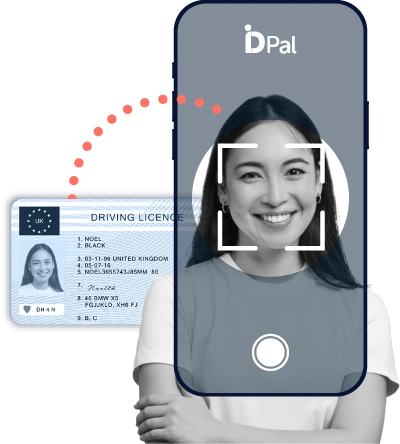
AML and KYC for accountancy firms
Automate KYC, KYB and AML checks to onboard clients faster, reduce compliance risk, and free partners and staff from manual checks.
KYC, KYB and AML compliance in one configurable platform
Individual, sole-trader and corporate clients in one workflow
250+ jurisdictions and 16,000+ ID documents

How does ID-Pal support accountancy firms?
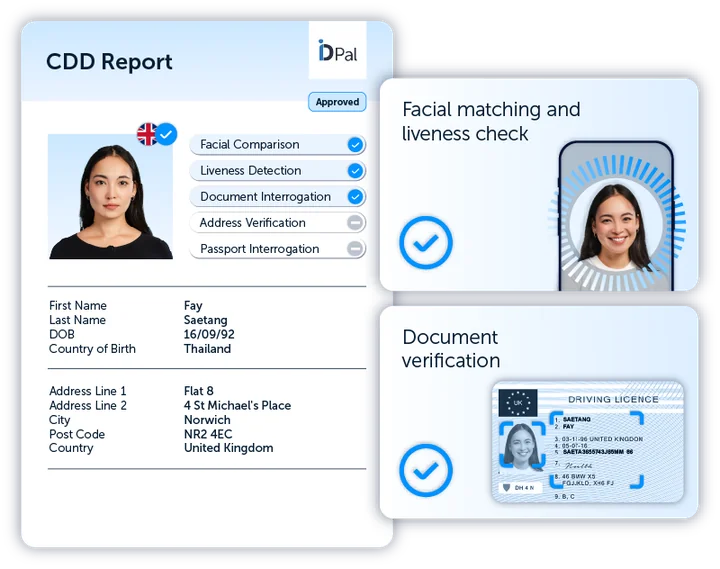
ID-Pal delivers KYC, KYB and AML compliance in a single configurable platform, which matches the range of clients an accountancy firm onboards. For individual and sole trader clients, it applies document authentication across 16,000+ identity documents, thousand-dimension biometric facial matching, and independently certified liveness detection (iBeta Level 1 and Level 2), with address e-verification against trusted data sources to remove the need for separate proof of address.
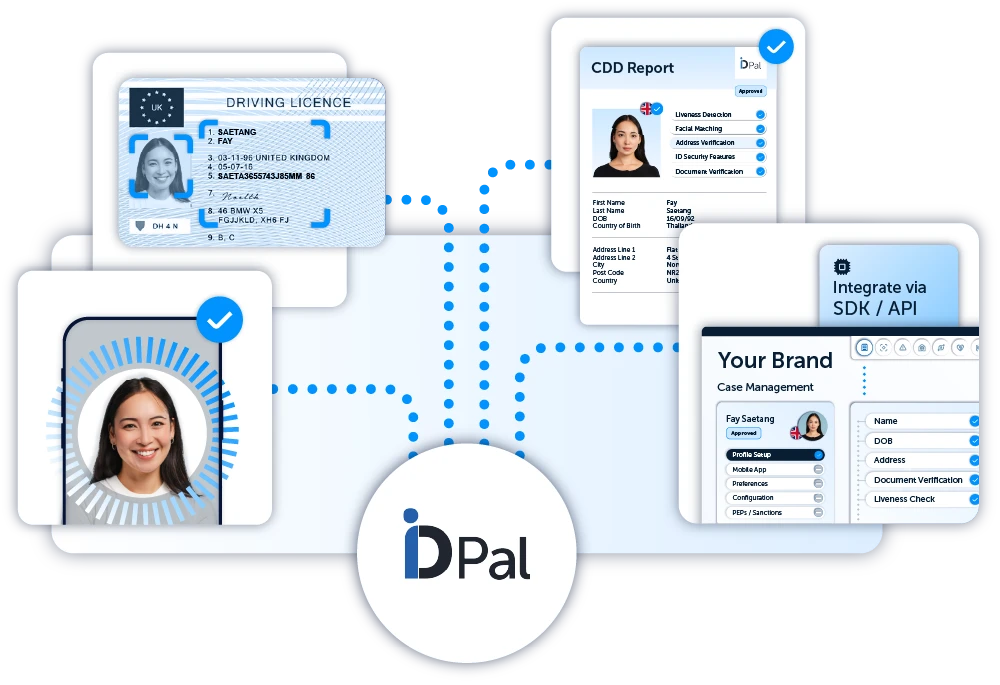
For corporate clients, its KYB suite confirms the entity and resolves ultimate beneficial ownership and persons with significant control, screening the business and the individuals behind it, with the enterprise KYB depth that followed the integration of NorthRow’s KYB and AML compliance platform into ID-Pal. AML screening runs against PEP, sanctions and adverse media sources with ongoing monitoring, and every check sits in a single case view with a comprehensive audit trail. The platform verifies across 250+ jurisdictions, is ISO 9001 and ISO 27001 certified and GDPR compliant, and deploys out of the box, via API and SDK, or through a native Salesforce integration, so a firm can be live quickly without a costly IT project.
Fully certified and industry accredited





Key takeaways
Cover every client type
An accountancy firm’s onboarding has to verify individual and business clients, resolve beneficial ownership for corporate clients, screen for risk, and evidence every decision to the firm’s AML supervisor.
KYC and KYB together
Accountancy client onboarding spans sole traders, individuals and companies with layered ownership, so it needs both KYC and KYB in one place.
One configurable platform
ID-Pal delivers KYC, KYB and AML compliance in one configurable platform, with individual verification, ownership resolution following the integration of NorthRow’s KYB platform, screening and ongoing monitoring, across 250+ jurisdictions and 16,000+ documents.
Five things that matter
Shortlist on five things: client-type coverage, ownership resolution, screening depth, ongoing monitoring, and a defensible audit trail.
What the platform covers
| Capability | What it does |
|---|---|
| Document Authentication | Verifies government-issued identity documents, across 16,000 or more document types |
| Biometric facial matching | Thousand-dimension facial matching confirms the client is the document holder |
| Liveness detection | Independently certified to iBeta Level 1 and Level 2, so a photo or replay does not pass |
| Address verification | Electronic verification against trusted data sources, removing separate proof of address |
| KYB and UBO resolution | Entity confirmation, ultimate beneficial owner and PSC identification through intermediate structures, across 250 or more jurisdictions |
| AML screening | PEP, sanctions and adverse media, on individuals and entities |
| Ongoing monitoring | Screening stays live across the engagement, not just at take-on |
| Case management and audit trail | Every check, decision and piece of evidence in a single case view |
| Deployment | Out of the box, via API and SDK, or through a native Salesforce integration |
Book a walkthrough of our IDV and AML solution for accountancy firms
Supporting 16,000+ ID documents and 400+ data sources, expand into 250+ jurisdictions faster while maintaining consistent controls across regions and customer types.

Trusted by leading accountancy firms
"ID-Pal has really streamlined our onboarding process and the customer service from their side is excellent."
UHY Farrelly Dave White

What makes client onboarding demanding for accountancy firms?
Accountancy firms onboard a wide mix of clients, from individuals and sole traders to companies with multiple layers of ownership, and each has to be verified and screened to the standard the firm’s AML supervisor expects. For a corporate client, that means identifying who ultimately owns and controls the business, not just confirming it exists. For every client, it means screening for risk and keeping a record that evidences the decision.
The challenge is doing this consistently across a broad client base, at onboarding speed, without tying up partners and staff in manual checks or leaving gaps a supervisor could find. Paper-based or fragmented processes are slow, error-prone and hard to evidence when a review comes. The aim is robust compliance and a low total cost of ownership, achieved without a costly transformation project.
What should an accountancy firm's onboarding process cover?
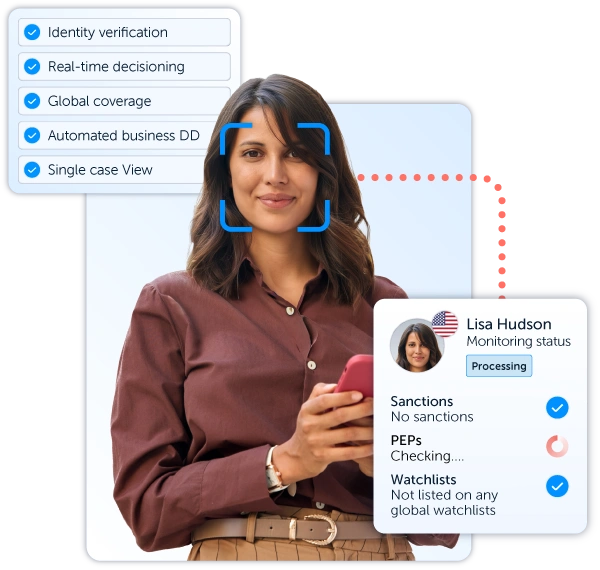
Accountancy client onboarding should verify the client, resolve ownership for corporate clients, screen for risk, and keep the relationship monitored, all evidenced in one place. The five components:
Individual and sole trader verification
Document authentication, biometric facial matching, liveness detection and address verification.
Corporate client verification
Confirm the business is registered and active, and identify its ultimate beneficial owners and persons with significant control, resolving ownership through intermediate structures.
AML screening
Screen individuals and entities against PEP, sanctions and adverse media sources, and record the outcome.
Ongoing monitoring
Keep screening live so a change in a client’s risk status is caught while the relationship is active.
Audit trail
Hold every check, decision and piece of evidence in a single case view the firm can show its AML supervisor.
See how accountancy firms use ID-Pal to simplify client verification and onboarding
In practice: UHY Farrelly Dawe White
UHY Farrelly Dawe White, an accountancy firm, used ID-Pal for seamless digital client onboarding. Icon Accounting and Parfrey Murphy are further accountancy references, the latter for streamlining its KYC process.
What are the common AML pitfalls for accountancy firms?
AML reviews of accountancy firms tend to surface the same weaknesses, and each maps to something a good platform removes.
Treating every client the same
Applying a single level of checking regardless of risk, so higher-risk clients are under-scrutinised and lower-risk ones over-burdened. A risk-based workflow applies standard or enhanced due diligence to the right clients.
Weak beneficial ownership checks
Accepting a corporate client’s stated ownership without resolving who ultimately controls it. KYB that follows the ownership chain closes this gap.
Onboarding-only checks
Verifying at take-on and never again, so risk that emerges later goes unnoticed. Ongoing monitoring keeps screening live.
Thin record-keeping
Being unable to evidence what was checked, when and why, when a supervisor reviews a file. A single case view with a full audit trail makes the work reviewable.
Manual, inconsistent processes
Checks that vary by staff member and by day. Automation applies the same standard every time.
What are a UK accountancy firm's AML obligations?
Accountancy firms that fall within scope of the UK Money Laundering Regulations must apply customer due diligence to their clients, identify the beneficial owners of corporate clients, understand the purpose and nature of the engagement, and keep records that evidence the work. Firms are supervised for AML purposes by their professional body or, in some cases, by HMRC, and are expected to take a risk-based approach rather than a one-size-fits-all check.
That risk-based approach is where a lot of firms come unstuck. Standard due diligence suits lower-risk clients; enhanced due diligence is expected where risk is higher, for example a politically exposed person, a client linked to a higher-risk jurisdiction, or a company with a complex or opaque ownership structure. Enhanced due diligence means going further on identity, ownership and source of funds, and applying closer ongoing monitoring. A process that cannot distinguish the two, and evidence which was applied to which client, is the kind of gap a supervisor’s review is designed to find. The precise obligations depend on the client, the engagement and the firm’s supervisor, so firms should confirm against current guidance.
How is KYB different from KYC for an accountancy firm?
KYC verifies an individual client. KYB verifies a corporate client and identifies who ultimately owns and controls it. Firms typically need both, because many accountancy clients are companies whose beneficial owners have to be identified and screened, not just confirmed to exist.
| KYB (individual clients) | KYC (corporate clients) | |
|---|---|---|
| What it verifies | A person, or a sole trader | A company and its owners |
| Core checks | Document, biometric, liveness, address | Registration and status, UBO/PSC identification, entity screening |
| Key question answered | Is this person who they claim to be | Is this business legitimate and who really controls it |
Running both on one platform gives one case view and one audit trail across every client type, rather than reconciling separate tools.

What should an accountancy firm ask when shortlisting a platform?
- Can you verify an individual client and a corporate client with complex ownership in one workflow?
- How do you resolve ultimate beneficial ownership for corporate clients?
- How does ongoing monitoring surface a change in a client’s risk after onboarding?
- What does the audit trail look like when our AML supervisor reviews a file?
- How quickly can a new client be onboarded without weakening the checks?
Frequently asked questions
What client due diligence do UK accountancy firms have to perform?
Firms must verify their clients, identify beneficial owners of corporate clients, understand the purpose of the engagement and keep records, under UK Money Laundering Regulations and their AML supervisor’s requirements. The precise obligations depend on the client and engagement, so firms should confirm against current guidance.
Can individual and business client checks run on one platform?
Yes. ID-Pal delivers KYC, KYB and AML compliance in a single configurable platform, giving one case view across individual and corporate clients.s.
How does ID-Pal help evidence onboarding to a supervisor?
Every check, decision and piece of evidence sits in a single case view with a comprehensive audit trail, so the firm can show exactly how a client was onboarded.
How quickly can an accountancy firm be up and running?
ID-Pal is an out-of-the-box solution that can be customised and deployed quickly, with API/SDK and native Salesforce options, so firms can start reducing manual checks without a lengthy overhaul.
How is ongoing monitoring different from a one-off check?
Ongoing monitoring keeps screening active after onboarding, so new risks are surfaced continuously rather than only at a periodic review.
When does an accountancy client need enhanced due diligence?
Enhanced due diligence generally applies where risk is higher, for example a politically exposed person, a client linked to a higher-risk jurisdiction, or a company with a complex ownership structure. It means going further on identity, ownership and source of funds, with closer monitoring. Firms should confirm the triggers with their supervisor’s current guidance.
Does the platform work for sole traders as well as companies?
Find out how we can help your business grow