

In today’s complex economy, maintaining transparency and accountability in business transactions is crucial. One significant aspect of achieving these goals is through the concept of beneficial ownership.
Beneficial ownership is a fundamental principle that allows for the identification of the individuals who ultimately own or control a company or asset. It refers to the individuals who enjoy the majority of economic benefits and privileges of owning an asset or exercising control over a legal entity, even if the assets or entities are registered under the names of others. It unveils the true owners behind corporate structures, trusts, or other legal arrangements; ensuring transparency and accountability.
In some cases, legal ownership and beneficial ownership can be held by different parties. For example, in a trust, the legal ownership of assets is held by the trustee, while the beneficiaries have the beneficial ownership and enjoy the benefits and profits generated by those assets.
Table of contents
▸ What is an Ultimate Beneficial Owner (UBO)?
▸ Why is ultimate beneficial ownership verification important?
▸ Financial crime in action: Major cases, fines and trends
▸ What are the benefits of identifying beneficial owners?
▸ The challenges in identifying UBOs
▸ A 7-step blueprint to UBO transparency
▸ UBO identification FAQs
What is an Ultimate Beneficial Owner (UBO)?
An Ultimate Beneficial Owner is a person, or entity, that is the ultimate beneficiary when an institution initiates a transaction. It also includes those legal persons who exercise ultimate effective control over a legal person or arrangement. A UBO is defined as the beneficiary of at least 25% of a company’s capital gains, company shares or voting rights, giving them significant control and a related interest in the business. Such control would include the right to remove most of the directors on the Board.
An Ultimate Beneficial Owner of a legal entity or a natural person that could be:
- Anyone that has direct/indirect control
- Shareholders
- Power of Attorney
- Guardians for minors
The UBO may be different from the legal owners or registered shareholders of an organisation. In some cases, individuals or entities may attempt to obscure the true ownership structure through complex ownership chains or nominee arrangements. UBO regulations aim to uncover these hidden owners and promote transparency in financial transactions. These requirements vary across jurisdictions, but they typically involve disclosing specific details about the UBO, including their name, residential address, nationality, and percentage of ownership/control. These disclosures are often mandated by government agencies, financial institutions, or regulatory bodies to enhance transparency and prevent financial crimes.
Why is ultimate beneficial ownership verification important?
Identifying UBOs is a key part of Anti-Money Laundering (AML) compliance when onboarding corporate clients. Under the UK’s Money Laundering Regulations, a UBO is anyone who ultimately owns or controls more than 25% of a company’s shares or voting rights, or who otherwise exercises significant control over the entity.
Regulators require firms to know who they are ultimately doing business with, especially when it comes to preventing money laundering, fraud, or terrorist financing. But pinpointing the individuals who ultimately control or benefit from a business can be incredibly difficult. Each layer might reveal shell companies, trusts, or opaque offshore structures designed to make ownership harder to trace.
The reality is that without clear UBO identification processes, firms risk becoming unwitting accomplices in financial crime. This can trigger harsh penalties from regulators like the Financial Conduct Authority (FCA) or international bodies such as the U.S. Treasury’s OFAC, not to mention the reputational fallout from being linked to criminal activity.
If you are dealing with a large multinational company with highly diverse ownership or a state-owned industry, for example, there is little likelihood of a human being (or natural person to give them the correct nomenclature) fitting the bill. But for the majority of small corporate entities, there is likely to be one or more natural persons who do. And they need to be identified.
In most circumstances, this is a straightforward matter. A joint-stock company, for example, is composed of shares (or equivalent). These shares tend to have “voting rights” (i.e., a say in how the company is run), and usually, each share has one vote. Where the legislation calls for firms to identify those who “own or control” more than 25%, that is what they are talking about. The shares give you ownership, and the votes give you control.
What are the benefits of identifying beneficial owners?
Investor confidence: Investors and shareholders seek transparency and clarity about the ownership structure of companies they invest in. Knowing the true owners behind a business enhances investor confidence as it reduces the risks associated with hidden agendas or undisclosed risks.
Improved risk assessment: Financial institutions and regulators can better assess the risks associated with clients and transactions by understanding the beneficial ownership structure. This information aids in the identification of potential money laundering activities, reputational risks, or exposure to politically exposed persons (PEPs).
Global standardisation: The global push for beneficial ownership transparency has led to the development of international standards and initiatives. Organisations such as the Financial Action Task Force (FATF) and the Global Forum on Transparency and Exchange of Information for Tax Purposes have established guidelines and best practices, promoting a standardised approach to beneficial ownership disclosure worldwide.
Cross-border cooperation: Sharing beneficial ownership information across jurisdictions fosters international cooperation in combating financial crimes. By collaborating and exchanging information, countries can prevent the misuse of legal structures for illicit purposes and strengthen their collective ability to address transnational challenges.
The challenges in identifying UBOs
For many organisations, getting into the details of Ultimate Beneficial Ownership is not straightforward. Bad actors are skilled at exploiting gaps in the system. Complex corporate structures are deliberately designed to make UBOs as hard to trace as possible. Multi-layered ownership chains, offshore jurisdictions, and nominee directors create opacity that even seasoned compliance professionals struggle to penetrate.
Offshore tax havens with minimal UBO disclosure requirements are particularly attractive. Jurisdictions like the British Virgin Islands and the Cayman Islands provide the perfect cover for hiding ownership, allowing criminals to bypass more stringent oversight in places like the UK.
And yet, even within the UK, criminals use inconsistent registry standards and trusts to their advantage. Trusts, for example, allow a trustee to hold legal ownership while the true beneficiary stays hidden, creating another layer of complexity.
Corporate webs can often be confusing to navigate and can take hours or days to manually unravel and identify attributes (confirming self-certified information such as company name, address, and registration details) and verify those attributes (such as ownership levels and financial reports), and understand where if necessary, to conduct enhanced due diligence.
Ultimate beneficial ownership verification can be further complicated as a result of the different ways a company can be constituted. Let’s look at some specific examples of what we mean by this.
There might be more than one class of shares issued by the company, which carry different voting rights. For example, there might be 100 shares issued in total, 70 “A” shares which carry one vote each and 30 “B” shares which carry 20 votes each. You could easily have a situation where 2 people own all the “A” shares, and 3 people own the “B” shares.
What would this mean in practice?
Each of the “A” shareholders owns 35 shares and, therefore, owns 35% of the company, so they are UBOs by virtue of ownership. Each of the “B” shareholders controls 10 “B” shares and therefore 200 votes each. Given that the total number of votes available is 670 (70 “A” share votes plus 20 x 30 = 600 “B” share votes”), each “B” shareholder is a UBO by virtue of control (200 votes equates to approx. 30% of the voting rights).
Not quite so straightforward.
What if there doesn’t appear to be a direct owner of a company?
To take this a stage further, what happens if there is no direct ownership of the company you are onboarding? Let’s say there are three shareholders, all corporate entities themselves, and they all have a variety of shareholders, some of whom are common to more than one company.
And what if some of those intermediate companies also have different shares with different voting rights? All of those shareholdings need to be worked out (along with voting right calculations if necessary) in order to establish who, if anyone, is a UBO.
Getting all that information is not always easy, which further complicates matters.
At this point, it would be nice to think that we’ve now covered all the requirements relating to legal entities, but there is still more.
One of the things that regulated entities are obliged to do is to consider the rationale for any particularly complex ownership structures. Previous fact sheets emanating from the Financial Action Task Force (FATF) have indicated that more than three layers of ownership should be considered as a possible starting point for complexity.
A 7-step blueprint to UBO transparency
Step 1: Verify the legal entity
Before identifying the individuals behind a company, it’s essential to confirm the legitimacy of the organisation itself. This step involves gathering core details about the company’s structure and official records.
How does ID-Pal help? Access reliable data from official registries and government sources to verify an entity’s legitimacy in a few clicks. Our platform streamlines this process, enabling you to confirm registration numbers, business type, registered address, and more with ease.
Step 2: Map out the corporate structure
Start by mapping out all entities and individuals involved, working through each layer, especially if it’s a complex corporate structure. Identify the main company and its subsidiaries, but don’t stop there. Examine holding companies, trusts, and joint ventures that could obscure the real UBOs.
Top tip: Map out the company’s ownership chain step by step, from the top to the bottom. If shares are held by another company, continue researching down that chain until you find the natural persons with control.
How can ID-Pal help? Our platform automatically identifies linked companies, subsidiaries, trusts, and holding companies, making it easier to trace ownership and uncover the true UBOs behind the corporate layers.
Step 3: Analyse public records
Many companies often file financial statements, tax records, of annual reports in multiple jurisdictions, sometimes revealing beneficial owners. While public filings might not disclose every UBO, they often hold the key to uncovering influential individuals linked to the company through directorships or shareholder roles, revealing the true power behind the scenes.
DO: Make sure to cross-reference directors with shareholder lists for discrepancies.
DO NOT: Assume that all financial records or public filings are accurate at face value. Companies may have reasons for omitting or obscuring certain details that require a deeper investigation.
How can ID-Pal help? With easy access to global financial documents, records, and filings, our platform helps you identify indirect ownership and influence, uncovering UBOs who may be hidden within complex structures.
Step 4: Look beyond public registries
Registries are a starting point, not the full picture. Cross-reference them with external, trusted data sources to uncover any discrepancies or gaps.
How can ID-Pal help? Integrations with global data sources like allow you to cross-reference ownership and corporate structures across multiple jurisdictions by combining registry data with these trusted sources.
Step 5: Identify the UBOs
With the ownership structure mapped out, it’s time to identify the individuals who have ultimate control over the company. UBOs may not always appear directly in the ownership records, so this is where careful scrutiny comes into play.
DO: Identify who has a significant ownership stake or influence over the company. This is typically anyone with a 25% or more ownership, but it can vary by jurisdiction.
DO NOT: Rely on ownership percentage alone. Pay attention to indirect control through voting rights or shareholder agreements, which could indicate influence that’s not reflected in ownership stakes.
How can ID-Pal help? Our platform cross-references multiple data sources and identifies control structures, helping you pinpoint UBOs even if they aren’t directly listed in the ownership records.
Step 6: Run KYC and ID&V checks
Now that you’ve gathered key details, it’s time to run KYC (Know Your Customer) and ID&V (Identity Verification) checks on the individuals identified as beneficiaries. This process verifies their identity and ensures they are legitimate, not involved in illicit activities, and fit within your risk appetite.
Top tip: For high-risk UBOs, implement Enhanced Due Diligence (EDD) to look deeper into their background and ongoing activities.
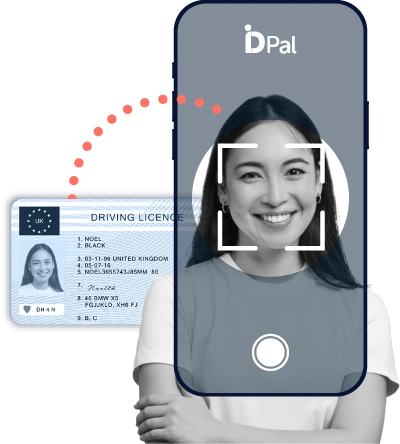
How can ID-Pal help? ID-Pal streamlines the KYC and ID&V process, providing instant verification of more than 16,000 ID documents, such as passports and driving licenses, and screening against global sanctions and PEP lists.
Step 7: Monitor UBOs on an ongoing basis
UBO verification isn’t a one-and-done process. Even after onboarding, continuous monitoring is essential. Circumstances change – an individual may be added to a sanctions list, become a PEP, or appear in adverse news at any time. Regular updates to your records keep you ahead of potential risks.
Top tip: Implement automated monitoring tools to track any changes in UBO status, including alerts for sanctions lists, PEPs, or adverse media. This ensures that you’re notified in real-time if anything significant occurs.
How can ID-Pal help? With round-the-clock ongoing monitoring, our system tracks UBOs for any changes to their risk profile. You’ll get real-time alerts if a UBO is added to a sanctions list, becomes a PEP, or is linked to any adverse media, ensuring you’re always up to date and ahead of potential threats.
UBO identification FAQs
What is an Ultimate Beneficial Owner (UBO)?
An Ultimate Beneficial Owner (UBO) is the individual who ultimately owns or controls a company or legal entity. This typically includes anyone who holds a significant percentage of shares or voting rights, or who exercises control through other means.
Why is identifying UBOs important?
Identifying UBOs is essential for transparency and risk management. It helps businesses understand who they are dealing with, prevents misuse of corporate structures for financial crime, and ensures compliance with regulatory requirements.
How do businesses identify UBOs?
Businesses identify UBOs by analysing ownership structures, reviewing shareholder registers, and tracing control through layers of entities. This may involve examining company documents and using external data sources to map out ownership chains.
What does verifying a UBO involve?
Verifying a UBO involves confirming their identity using reliable documentation such as passports or national IDs, and validating their ownership or control in the business. This ensures the information collected is accurate and up to date.
What challenges are involved in identifying UBOs?
Common challenges include complex ownership structures, use of offshore entities, and limited access to reliable data. These factors can make it difficult to trace true ownership and require more in-depth investigation and ongoing monitoring.