

If you’re responsible for onboarding business clients at a financial services firm, you know the reality of business onboarding AML checks: scattered workflows, time-consuming documentation reviews, and the constant pressure to keep up with evolving regulations. These challenges consume valuable resources while leaving compliance gaps that can expose your organisation to regulatory action.
This guide walks you through everything you need to know about automating AML checks during business onboarding. You’ll learn why these checks are becoming harder, what causes compliance gaps, and how automation addresses these issues. By the end, you’ll have a clear framework for implementing automated workflows that reduce risk and speed up your review process.
Key takeaways: How to automate business onboarding AML checks
- Fragmented workflows and disconnected tools create AML compliance gaps that increase regulatory exposure for financial services firms
- Automating document verification, UBO discovery, and sanctions screening removes bottlenecks and reduces human error during onboarding
- Risk-based automated workflows route high-risk entities for enhanced review while fast-tracking low-risk businesses
- ID-Pal combines identity verification, business checks, and AML screening into a single automated workflow for faster approvals
- Ongoing monitoring and real-time alerts help you maintain compliance throughout the customer lifecycle, not just at onboarding
What are business onboarding AML checks?
Business onboarding AML checks are the verification steps your firm performs before establishing a relationship with a corporate client. These checks confirm that the business is legitimate, identify who owns and controls it, and screen all relevant parties against sanctions lists and other watchlists.
The goal is straightforward: confirm you’re not doing business with entities connected to money laundering, terrorist financing, or other financial crimes. However, the execution is anything but simple.
A thorough business onboarding AML process includes company registration verification, director and shareholder identification, Ultimate Beneficial Owner (UBO) discovery, PEPs and sanctions screening, adverse media checks, and ongoing monitoring. Each element requires data from different sources, often across multiple jurisdictions.
Why do manual business onboarding AML processes create compliance gaps?
When your AML checks rely on manual effort, several problems emerge. First, analysts spend significant time chasing documents, cross-referencing data across systems, and piecing together ownership structures. This resource drain leaves less capacity for investigating genuine red flags.
Second, manual processes introduce inconsistency. Different team members may apply screening criteria differently, document decisions inconsistently, or miss critical information when workloads peak. This inconsistency creates audit vulnerabilities and makes it difficult to demonstrate governance controls.
Third, relying on separate vendors for each verification element creates data silos. When your document authentication, biometric checks, and sanctions screening live in disconnected systems, you lose the unified view needed to make informed decisions quickly. Information falls through the cracks.
| Manual KYB onboarding | Automated KYB onboarding |
|---|---|
| Multiple systems | Single workflow |
| Manual KYB checks | Automated business verification |
| Separate data searches | Integrated screening |
| Manual audit trail | Automatically recorded evidence |
| Higher operational cost | Greater operational efficiency |
| Slower customer approvals | Faster onboarding decisions |
The resource problem
Consider what happens when a business client needs verification across multiple jurisdictions. Your team must access different company registries, navigate varying transparency levels, and reconcile inconsistent data formats. A single complex ownership chain can consume hours of analyst time.
This time-intensive approach doesn’t scale. As your client base grows, either onboarding slows down or corners get cut. Neither outcome serves your compliance objectives or your business goals.
The inconsistency problem
Without standardised workflows, decisions vary between analysts. One team member might escalate a case that another would approve. This creates risk: if regulators examine your onboarding decisions, inconsistent approaches are difficult to defend.
According to a 2025 FinCrime Frontier report published by AML Intelligence, 80% of compliance leaders are planning AI adoption to address these exact challenges, recognising that manual approaches cannot meet current regulatory expectations.
What are the main causes of fragmented AML workflows?
Fragmented workflows typically result from organic growth. As firms add new compliance requirements, they bolt on additional tools and vendors. Over time, this creates a patchwork of solutions that don’t communicate effectively with each other.
Common causes include using separate vendors for KYC versus KYB checks, maintaining different systems for different jurisdictions, relying on spreadsheets for case tracking and communication, storing documents across multiple platforms, and lacking a single source of truth for customer risk profiles.
This fragmentation affects more than efficiency. It creates compliance gaps because no single system captures the complete picture. When information lives in silos, meaningful risk patterns become invisible.
Speed without sacrificing accuracy
Automation removes the bottlenecks that slow manual reviews. Low-risk businesses move through verification quickly, while higher-risk entities automatically route to enhanced review. Your team focuses attention where it matters instead of on routine checks. This risk-based approach aligns with regulatory expectations. Regulators want to see proportionate responses to different risk levels, not one-size-fits-all processes that treat every applicant identically.
Consistency across decisions
When rules are built into automated workflows, every case follows the same logic. Your risk thresholds apply uniformly. Documentation requirements trigger automatically based on entity type, jurisdiction, or sector. This consistency strengthens your compliance posture and simplifies audits.
What should an automated business onboarding AML workflow include?
An effective automated workflow addresses every stage of business verification. Here’s what each component should deliver:
- Company verification: The system should validate company registration details against official registries. This includes confirming the business exists, checking its active status, and verifying registered address information. ID-Pal connects to 400+ trusted data sources globally, covering company records across 250+ jurisdictions.
- Ownership discovery: Automated UBO identification pulls shareholder and ownership data to reveal who ultimately controls the business. This includes mapping complex corporate structures with multiple layers of ownership. Without automation, tracing beneficial ownership across jurisdictions can consume hours per case.
- Director and PSC verification: Directors and Persons with Significant Control need identification and verification. Automated workflows flag individuals for identity verification and route them through document checks and biometric confirmation where required.
- AML screening: Every identified individual and the business entity itself should be screened against PEPs lists, sanctions databases, and adverse media sources. ID-Pal screens against 6,000+ global watchlists and 20,000+ adverse media sources, with results delivered in real time.
- Risk scoring: Automated risk scoring applies your policies consistently. The workflow routes cases based on risk level: fast-tracking standard applications while escalating complex or high-risk cases for human review. You retain full control over thresholds and decision logic.
- Documentation and audit trail: Every step generates documentation automatically. Client Due Diligence reports capture verification outcomes, screening results, and decision rationale. This creates the audit-ready records regulators expect without additional manual work.
What role does identity verification play in business onboarding?
While business verification confirms company details, individual identity verification confirms the people behind the business. Directors, UBOs, and authorised representatives all require verification to ensure they are who they claim to be.
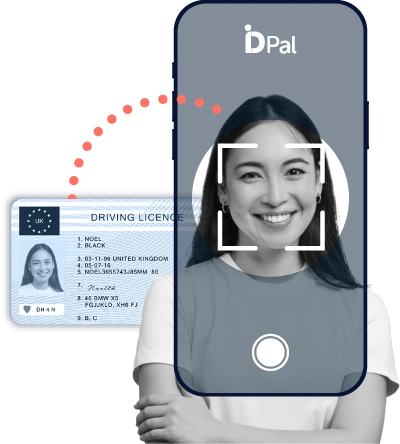
Effective identity verification during business onboarding includes document authentication to confirm ID documents are genuine, biometric facial matching to confirm the document belongs to the person presenting it, and liveness detection to confirm a real person is present during verification.
ID-Pal performs these checks using 100% AI-powered technology with zero access to customer data. The platform supports 16,000+ identity documents from across 250+ jurisdictions, delivering verification results in seconds rather than hours.
Why individual verification matters for business AML
A business may pass company-level checks while still presenting risk through its associated individuals. A director might be a PEP. A UBO might appear on a sanctions list. A shell company might be controlled by bad actors who would fail individual screening. Verifying individuals connected to the business closes these gaps. It confirms that the people exercising control are legitimate and not attempting to obscure their involvement through corporate structures.
How do you maintain compliance after initial onboarding?
Business onboarding AML checks don’t end when you open the account. Regulatory expectations include ongoing monitoring to detect changes that might affect risk profiles.
What changes require monitoring?
Several events should trigger a compliance review: changes in ownership or beneficial ownership, new directors or significant control persons, changes in business status or registration details, updates to sanctions lists or PEP databases, and adverse media coverage concerning the business or associated individuals.
Automated ongoing monitoring
This continuous approach meets regulatory expectations that firms stay informed throughout the customer lifecycle, not just at onboarding. When risk profiles evolve, you can reassess and take appropriate action.
What are the benefits on unifying KYC, KYB and AML in one platform?
Using a single platform for all verification and screening activities offers several advantages over fragmented approaches.When regulators request evidence of your AML controls, you can demonstrate your processes clearly. Every action is logged, every decision is documented, and every verification step has a timestamp. This transparency builds confidence with supervisors.
ID-Pal’s AML compliance solution brings these elements together, combining individual and business verification in a single workflow with automated audit trails for every submission.
How does ID-Pal supported automated business onboarding checks?
ID-Pal addresses the challenges of business onboarding AML through a unified platform. The solution combines company verification, ownership discovery, identity verification, and AML screening into a single workflow.
With coverage spanning 250+ jurisdictions, 400+ data sources, and 6,000+ global watchlists, ID-Pal gives you the reach needed to verify business clients wherever they operate. Every submission generates an automatic Client Due Diligence report, maintaining audit-ready documentation without manual effort.
The platform’s configurable workflows let you implement risk-based approaches that meet regulatory expectations while keeping onboarding moving. Compliance teams retain control over decisions while routine checks run automatically. The result is faster approvals for legitimate businesses and focused attention on genuine risks.
FAQs about how to automate business onboarding checks
What is the difference between KYC and KYB in AML compliance?
KYC (Know Your Customer) focuses on verifying individual identities, while KYB (Know Your Business) verifies corporate entities and the people behind them. ID-Pal combines both into a single platform, allowing you to verify the business structure and screen associated individuals against watchlists in one workflow.
How long does automated business onboarding take compared to manual processes?
Automated verification typically completes in seconds for straightforward cases. ID-Pal delivers real-time results for company checks, identity verification, and AML screening. Manual processes can take days or weeks depending on complexity, particularly when tracing ownership across jurisdictions.
What are the regulatory requirements for business onboarding AML checks?
Requirements vary by jurisdiction but generally include verifying business identity, identifying beneficial owners, screening against sanctions and PEP lists, conducting risk-appropriate due diligence, and maintaining records. ID-Pal’s automated workflows help you meet these requirements consistently while generating audit-ready documentation.
Can automated AML systems handle complex ownership structures?
Effective platforms automatically trace ownership chains and identify UBOs even in layered structures. ID-Pal accesses 200+ beneficial ownership registries globally to map control relationships and flag individuals requiring verification or enhanced scrutiny.
Defensibility requires consistent application of documented policies and complete audit trails. ID-Pal automatically logs every verification step, screening result, and decision, creating the evidence regulators expect. Configurable rule engines ensure policies apply uniformly across all cases.
What ongoing monitoring is required after business client onboarding?
Regulators expect firms to monitor for changes affecting risk profiles, including ownership changes, new sanctions designations, and adverse media. ID-Pal supports ongoing monitoring with daily refresh rates against updated watchlists and alerts when circumstances change.
Take the manual work out of business onboarding