
What does an estate agency need to check under the UK Money Laundering Regulations?
An estate agency business must register for anti-money laundering supervision, carry out customer due diligence on both the buyer and the seller, identify the beneficial owners behind any corporate or trust party, screen those parties against sanctions and politically exposed person lists, apply enhanced measures where risk is higher, and keep a dated record of every check and decision.
Last updated: October 2026 · Reviewed by ID-Pal

How does automation change this?
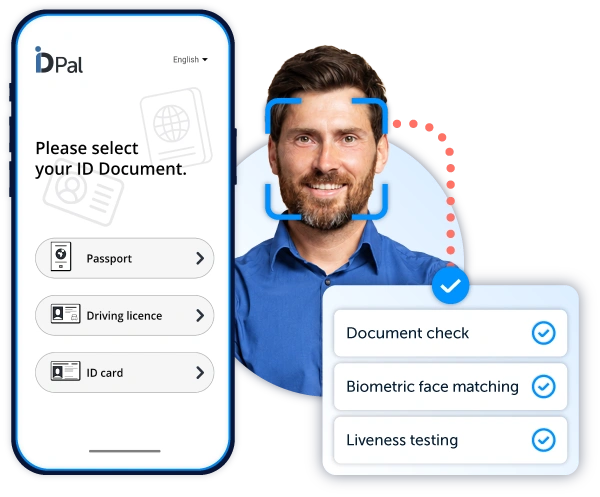
Automation removes the collection and reconciliation work underneath the obligation. It does not move the obligation. A configured platform runs document authentication, biometric matching and screening in one pass, so a standard-risk party completes in minutes and the evidence lands in one place.
ID-Pal delivers KYC, KYB and AML compliance, configurable to the agency’s own risk rules, supporting 16,000+ identity documents across 250+ jurisdictions with liveness detection independently certified to iBeta Level 1 and Level 2.
For agencies with corporate buyers, the same case resolves ultimate beneficial ownership through intermediate structures rather than stopping at the registered name.
Sherry FitzGerald and Knight Frank both run client verification this way.
Read next: Which AML and KYC platforms should a UK or Irish estate agency shortlist in 2026?
Fully certified and industry accredited






AML checks for estate agents: key takeaways
A risk assessment first
A risk assessment for the transaction, made before the checks rather than after them.
Identity evidence for each party
Identity evidence for each party, capable of showing that the person presenting the document is the person the document describes.
Screening results, recorded
Screening results, with the outcome recorded whether or not there was a match.
A dated, attributable decision
A decision, dated and attributable, that reflects the risk assessment.
What the platform covers
| Party | What has to be established |
|---|---|
| Seller | Identity verified from a reliable independent source |
| Buyer | Identity verified from a reliable independent source |
| Corporate or trust party | Entity status confirmed, and the ultimate beneficial owners identified through any intermediate structures |
| All of the above | Screened against sanctions, politically exposed person and adverse media sources |
Where a party is a company, verifying the company is not sufficient on its own. The individuals who ultimately own or control it have to be identified, and screened.
Book a walkthrough of our IDV and AML solution for estate and letting agents
Supporting 16,000+ ID documents and 400+ data sources, expand into 250+ jurisdictions faster while maintaining consistent controls across regions and customer types.

AML checks for estate agents
Who has to be verified?
Both parties to the transaction. This is the point agencies most often get wrong, because commercial instinct says the customer is the party who instructs and pays.
Who is in scope?
Scope follows the activity rather than the job title, so an agency handling both sales and qualifying lettings carries the obligation across both.
Estate agency businesses
Estate agency businesses are in scope. Registration with the supervisor comes first. Trading while unregistered is itself an offence, and it is one of the more straightforward failures for a supervisor to identify.
Letting agency businesses
Letting agency businesses are in scope only where the tenancy term is for at least one month and the monthly rent is £10,000 or more at any point during the term (source: gov.uk).
When do enhanced measures apply?
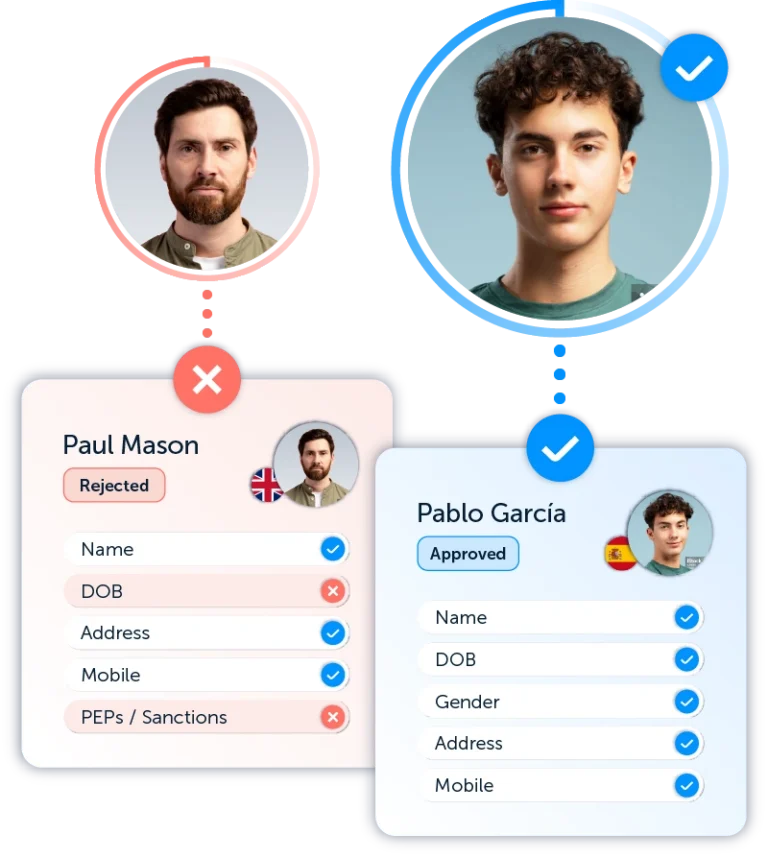
Enhanced due diligence generally applies where risk is higher, for example a politically exposed person, a link to a high-risk jurisdiction, an unusually complex ownership structure, or a transaction that does not fit the parties involved.
Enhanced measures mean going further: additional verification, closer scrutiny of the transaction, the agency’s own assessment of source of funds, and senior sign-off. The triggers depend on the agency’s risk assessment and its supervisor’s current guidance, so these should be confirmed rather than assumed.
What does the file have to show afterwards?
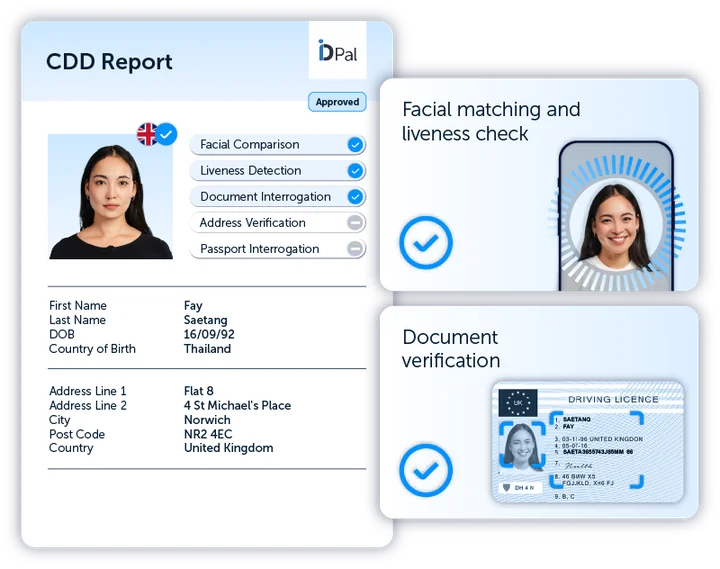
The file has to show what was checked, on whom, on what date, what the screening returned, what risk rating was applied, who approved it, and what evidence the decision rested on.
The recurring enforcement theme in property is not agencies skipping checks. It is agencies unable to evidence the checks they ran, because identity documents sat in one system, screening in another, and the decision in somebody’s inbox. A single case view with a complete audit trail per transaction removes that problem rather than managing it.
Frequently asked questions
Does an estate agent have to check the buyer?
Yes. An estate agency business is treated as acting for both the seller and the buyer for due diligence purposes, so customer due diligence applies to both parties rather than only the instructing client.
Do letting agents have the same obligations?
Letting agency businesses are in scope only for lettings where the term is at least one month and the monthly rent is £10,000 or more at any point during the term (source: gov.uk). For those lettings they carry equivalent obligations, applied to landlords and tenants. Agencies should confirm their position against current guidance.
What if the buyer is an overseas company?
The entity has to be verified and the individuals who ultimately own or control it identified and screened. Jurisdictional coverage decides whether that can be completed at all, which is why document and registry coverage is a practical constraint rather than a technical detail.
Is a copy of a passport enough?
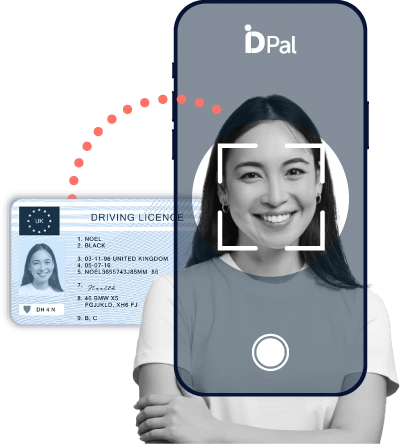
No. A document copy shows a document exists. It does not show that the person presenting it is the person it describes, which is what biometric matching and certified liveness detection establish.
How long do records have to be kept?
Records must be retained for the period set by the Regulations and be retrievable in a form that evidences the decision. Agencies should confirm the current retention period with their supervisor.
Can verification be completed remotely?
Yes, where the platform supports the party’s documents and can prove the person is genuinely present. Remote verification is now standard practice in property, including for overseas buyers.
Find out how we can help your business grow
Lorem ipsum dolor sit amet, consectetur adipiscing elit. Ut elit tellus, luctus nec ullamcorper mattis, pulvinar dapibus leo.