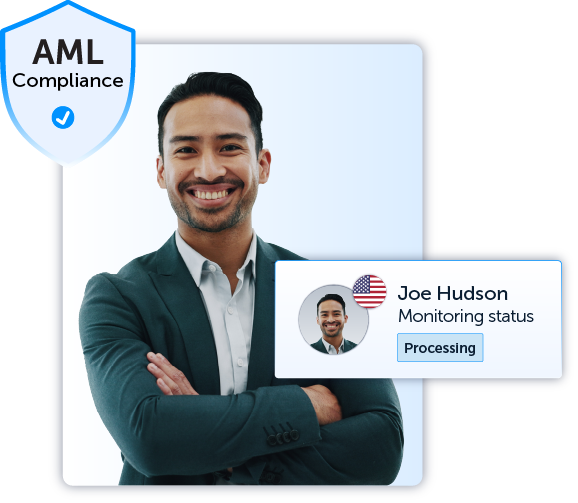
Simplify complex Anti-Money Laundering (AML) and due diligence processes into a single, efficient workflow, ensuring compliance with legislation in any jurisdiction.
Detect high-risk customers and protect revenue
Automate PEP, sanctions and adverse media screening
Generate audit-ready AML reports instantly
Reduce onboarding delays and compliance bottlenecks
AML compliance challenges are growing faster than compliance teams
Our ID verification solutions are the easiest way for businesses to meet complex AML requirements. With compliance built in, organisations enjoy real-time verification of customers and businesses, flexible risk-based due diligence, and PEPs, sanctions and watchlist checks across the globe.
Combined with ongoing monitoring, full auditability and zero access to customer data, our approach is designed to streamline and simplify even the most complex AML compliance requirements.
Verify and onboard customers faster, without additional friction
Onboard legitimate customers faster
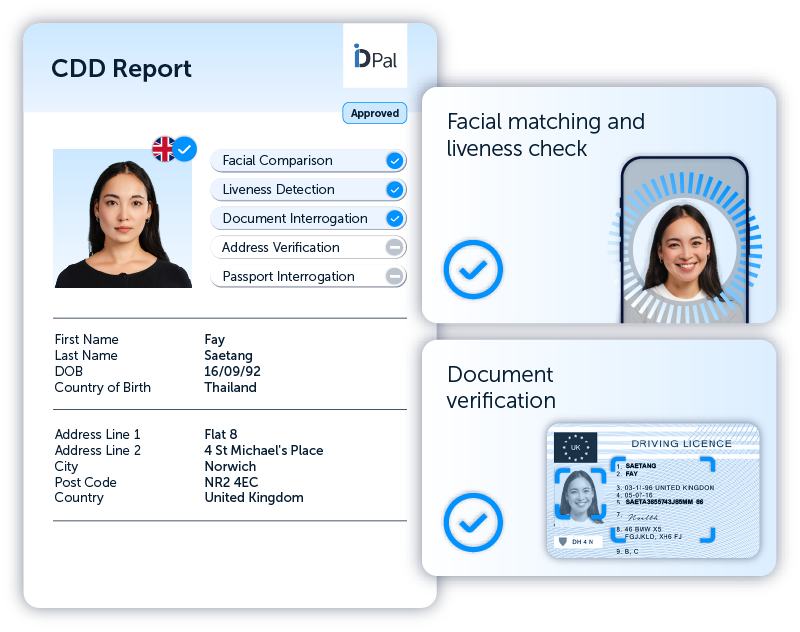
Automated identity verification and AML checks help compliance teams approve low-risk customers in real-time, reducing onboarding delays and abandonment rates. ID-Pal verifies identities, validates addresses and screens against global watchlists within seconds, helping businesses accelerate revenue generation without compromising compliance.
Reduce false positives and manual reviews
Traditional or legacy AML complaince systems generate large volumes of false positives that drain compliance resources. ID-Pal uses advanced AI-powered matching and risk-based workflows to improve AML screening accuracy, helping teams focus attention on genuine high-risk cases instead of repetitive manual checks.
Stay compliant and audit-ready at all times
Every verification generates a secure, timestamped Client Due Diligence report with a complete and robust audit trail. Compliance teams can quickly demonstrate regulatory adherence, simplify investigations and respond confidently to audits or regulator requests instantly.
Scale AML compliance globally
Supporting 16,000+ ID documents and 400+ data sources, expand into 250+ jurisdictions faster while maintaining consistent AML controls across regions and customer types.
How ID-Pal automates AML checks and compliance workflows
ID-Pal combines identity verification, AML screening and customer due diligence into a single automated workflow designed to support regulatory compliance while reducing operational overhead.
Our platform enables you to:
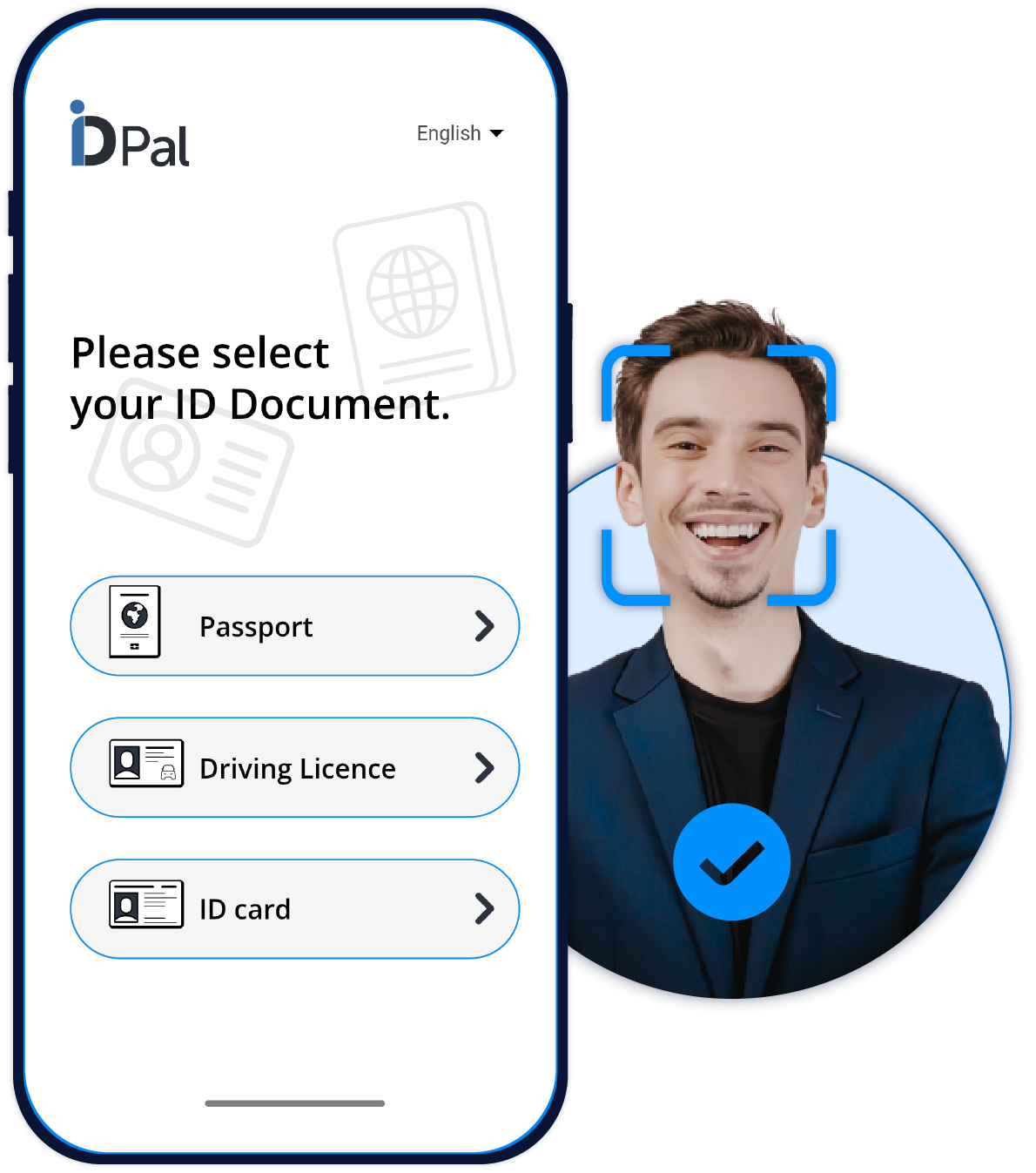
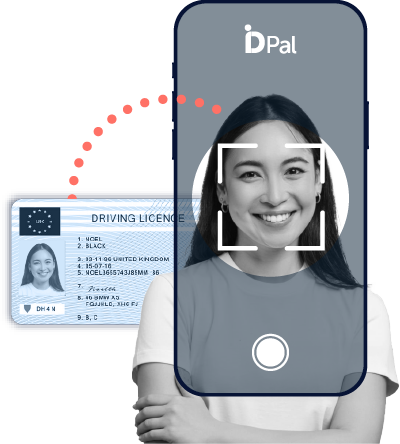
Verify customer identities remotely
Authenticate government-issued identity documents
Perform biometric liveness verification
Screen individuals and businesses against global sanctions and watchlists
Identify Politically Exposed Persons (PEPs)
Detect adverse media indicators
Generate audit-ready compliance reports
Support ongoing monitoring requirements
Identity verification and AML screening checks are completed in real-time, enabling compliance teams to make faster onboarding decisions while maintaining robust AML controls.
Fully certified and industry accredited
The AML compliance platform with enterprise-grade security and data protection
ID-Pal is designed with a privacy-first architecture intended to minimise unnecessary exposure to customer data during the verification process. Security capabilities include:
Encrypted data transmission
All customer data is encrypted, whether in transmission or at rest.
Secure cloud infrastructure
Enterprise-grade cloud infrastructure designed for resilience and availability.
Role-based access controls
Control access to data through fully configurable user permissions.
Detailed audit logging
Maintain a record of activity to support compliance and internal governance.
Configurable data retention policies
Define how long verification data is stored to align with business requirements.
GDPR-aligned workflows
Data privacy compliance with GDPR principles at the core of the platform.
Zero data access principles
ID-Pal has no access to customer data at any stage of the process.
Flexible integration and deployment
Seamless integration with existing compliance and onboarding systems through APIs and SDKs.
Robust ongoing AML monitoring tools and risk management
AML compliance extends beyond initial onboarding. ID-Pal supports ongoing customer monitoring strategies by enabling organisations to continuously rescreen customers against updated sanctions lists, identify newly classified politically exposed persons (PEPs), and monitor adverse media developments. The platform helps organisations maintain accurate and up-to-date customer risk profiles while supporting periodic compliance reviews.
ID-Pal integrates screening against law enforcement watchlists, financial crime databases, international regulatory lists, and adverse media sources to help organisations strengthen their ongoing compliance and risk management processes.
Different customers present different levels of compliance risk.
ID-Pal enables organisations to implement risk-based onboarding workflows that adapt verification and screening requirements based on geography, customer type, transaction profile, industry exposure, politically exposed status and source-of-funds indicators.
Risk scoring and configurable workflows help compliance teams apply enhanced due diligence where required while streamlining onboarding for lower-risk customers.
Why businesses choose ID-Pal for effective AML compliance solutions
Stay compliant with leading AML compliance software that meets the needs of any jurisdiction and instantly adapts to regulatory changes.
Individual client profiles
Simple toggle on/off customisation supports compliance with AML requirements specific to a jurisdiction or profile. Risk thresholds are fully configurable to align screening sensitivity with internal risk frameworks and regulatory obligations.
Compliant by design
A risk-based approach for identity verification and AML compliance is core to the solution. Client due diligence reports automatically generate per submission – stored securely and provide a full audit trail.
Manage and reduce fraud risk
Our award-winning solution is proven to combat those fraudsters exploiting weaknesses in compliance processes. ID-Pal secures all channels, reducing the risk of all common fraud types and AI driven threats.
Decrease false positives
Accurate first-time KYC capture and advanced identity and address verification reduce false positives and compliance workload, while increasing confidence in customer identities.
Reduce compliance costs without increasing risk - get your free demo today
Have more questions? We’re here to help! Get in touch to find out more about our AML compliance solutions.
What made the difference is how easy it was to deploy ID-Pal. We needed something that can seamlessly integrate with existing systems and transform our onboarding experience.
Through our alliance with ID-Pal, we have created an app that helps businesses verify the identities of their customers easily, securely, and conveniently.
ID-Pal has the technology to support our aims and has helped us to quickly offer compliant, reliable virtual individual verification at a time when we needed it most.
We work together with ID-Pal to further enhance our on-boarding experience, bringing efficiencies to our clients and partners whilst also achieving our regulatory compliance objectives.
ID-Pal’s facial matching, liveness and biometric checks have proved very robust and secure. It has considerably reduced the time it takes to onboard new clients onto our wealth platform.
ID-Pal’s solution has not only saved us a significant amount of money but has also dramatically improved customer satisfaction by creating a smoother, more secure onboarding process.
Deep dive into AML compliance with our knowledge base
The ultimate guide to buying the best AML software
As regulatory pressures rise, our ultimate guide to buying the best AML software cuts through the noise to help compliance leaders make confident, informed decisions.
Financial crime and fraud: Practical steps for AML compliance teams
For compliance professionals in regulated firms, the battle against fraud is an ongoing challenge that demands vigilance, expertise, and proactive measures.
A complete guide to financial crime and AML compliance
This guide brings together the key elements of financial crime and AML compliance to give a clear, practical view of what AML looks like today and what it takes to get it right.
AML (Anti-Money Laundering) compliance refers to the set of laws, regulations, and procedures designed to prevent individuals and entities from disguising illegally obtained funds as legitimate income. Essential for maintaining the integrity of the global financial system, AML compliance helps deter criminal activities by requiring financial institutions and other regulated entities to monitor customer behavior, conduct due diligence, and report suspicious activities.
For businesses, adhering to AML regulations is crucial not only for preventing financial crime but also for avoiding hefty penalties from non-compliance. It protects the reputation of institutions, enhances investor confidence, and ensures the stability and transparency of financial markets. Implementing robust AML screening software allows organizations to detect and prevent money laundering and terrorism financing activities effectively, fostering a secure and trustworthy business environment.
What are the key components of an effective AML compliance programme?
An effective AML compliance program comprises several key components, designed to enforce compliance and mitigate risks:
Transaction monitoring: Continuously observing customer transactions to identify and report suspicious activities that might suggest money laundering.
Record keeping: Maintaining detailed records of customer identification, transactions, and reporting for a specified period, as required by law.
Employee training: Educating staff about AML regulations, how to identify money laundering activities, and the procedures for reporting suspicious transactions.
Compliance Officer: Appointing a dedicated individual responsible for overseeing the AML compliance systems, ensuring policies are up-to-date and effectively implemented.
Why is identity verification critical as part of AML compliance?
Technology has significantly transformed anti-money laundering (AML) compliance by introducing sophisticated tools that automate and enhance the effectiveness of compliance processes.
Artificial Intelligence used in identity verification improves the efficiency and accuracy of fraud detection, allowing for the identification of fraudulent actors committing money laundering.
Identity verification platforms streamline AML compliance processes, offering dynamic risk assessment, efficient reporting tools, and automation of customer due diligence (CDD) reporting.
By leveraging these technologies, firms strengthen their AML compliance programs, ensuring more robust protection against financial crime while optimising operational efficiency.
Who must comply with AML regulations?
AML requirements differ depending on jurisdiction, but generally apply to regulated entities in or adjacent to the finance sector. These include banks, payment institutions, electronic money institutions, cryptoasset service providers, gambling operators, professional services firms, and trust or company service providers.
What is Customer Due Diligence (CDD)?
Customer Due Diligence is the process of identifying and verifying a customer before establishing a business relationship. It involves confirming identity using reliable sources, understanding the purpose and expected nature of the relationship, and assessing the customer’s money laundering risk. CDD must be kept up to date and refreshed when risk factors or regulations change.
Enhanced Due Diligence (EDD) applies when a customer or transaction presents a higher risk of money laundering or terrorist financing. This includes politically exposed persons, customers linked to high-risk jurisdictions, complex ownership structures, or unusual activity.
How does AML differ from KYC?
Know Your Customer (KYC) is a subset of AML that focuses on identity verification at onboarding in order to confirm who they are. AML is broader and covers ongoing monitoring, risk management, reporting obligations, governance, and internal controls. Completing KYC checks alone does not satisfy full AML compliance requirements.