
Identity document fraud has changed faster than you think. No longer limited to amateur attempts involving altered passports and poorly edited utility bills, the methods used by today’s fraudsters have become increasingly sophisticated, accessible, and difficult to spot.
The challenge is that fraudsters no longer need specialist equipment or technical expertise to create convincing fake documents. Advanced editing software, artificial intelligence tools, online document templates, and illicit document marketplaces have dramatically lowered the barriers to entry. A fraudulent identity can now be created, modified, or manipulated in minutes.
The consequences extend far beyond a failed onboarding process. Identity document fraud can expose your organisation to financial crime, sanctions breaches, money laundering risks, reputational damage, regulatory scrutiny, and substantial financial losses.
Understanding the different forms of identity document fraud is the first step towards building stronger controls and reducing risk exposure.
Forged documents
Forged documents are among the most widely recognised forms of identity fraud. In this scenario, a fraudster creates an entirely fake document from scratch while attempting to make it appear genuine.
Historically, these documents were relatively easy to identify because they lacked security features, contained spelling mistakes, or displayed poor image quality. Modern forgeries are considerably harder to detect.
A criminal may use high-resolution scans of genuine passports, driving licences, or national identity cards as the foundation for a convincing counterfeit. Professional printing equipment can replicate holograms, watermarks, and other visual security elements with surprising accuracy.
For example, a fraudster attempting to open multiple bank accounts may create a counterfeit passport using details stolen from a data breach. To an untrained reviewer conducting a manual inspection, the document could appear legitimate.
The rise of online marketplaces has also made forged identity documents easier to obtain. Criminal networks openly advertise counterfeit passports, driving licences, residence permits, and supporting proof-of-address documentation to buyers across the globe.
For compliance teams, this means visual inspection alone is becoming increasingly unreliable as a primary defence.
Altered documents
Unlike a forged document, an altered document begins life as a genuine credential.
The fraudster takes a legitimate document and changes specific information to suit their objectives. This could involve modifying the name, date of birth, address, document number, photograph, or expiry date.
Digital editing tools have transformed how these attacks are carried out. A scanned passport can be modified using image-editing software, with the altered version then submitted during a digital onboarding process.
One common example involves changing the date of birth on an identity document to bypass age restrictions. Another involves replacing the photograph while leaving all other information intact.
Fraudsters may also alter supporting documents such as utility bills, bank statements, council tax letters, or tenancy agreements to create a false proof of address.
What makes altered documents particularly challenging is that many of the security features remain genuine because the original document was authentic. This can make detection significantly harder during manual reviews.
Stolen genuine documents
Not every identity document fraud case involves a fake document. Many criminals simply use genuine documents that belong to someone else.
These documents may be stolen physically through theft or obtained digitally through phishing attacks, malware infections, data breaches, or social engineering schemes.
A fraudster using a genuine passport belonging to another individual may attempt to impersonate the rightful owner during account opening or customer verification. This approach can be highly effective because the document itself passes authenticity checks. The weakness lies in confirming that the person presenting the document is genuinely entitled to use it.
Criminal groups often purchase stolen identity records in bulk from dark web marketplaces. These records may include passports, driving licences, selfies, utility bills, bank statements, and other personal information needed to pass identity verification procedures.
For compliance teams, this highlights the importance of linking document verification with biometric verification and liveness detection rather than relying solely on document authenticity checks.
Synthetic identity fraud
Synthetic identity fraud has become one of the fastest-growing threats facing regulated firms. Rather than stealing an entire identity, fraudsters combine genuine and fabricated information to create a completely new persona.
A synthetic identity may use a legitimate national insurance number alongside a false name, fake address, and invented date of birth. In other cases, criminals combine details from multiple real individuals to build a new identity profile.
The objective is often to establish credibility gradually. Fraudsters may open low-risk accounts, build transaction histories, and create a seemingly legitimate digital footprint before exploiting financial products or services.
Synthetic identities are particularly difficult to detect during traditional onboarding processes because individual pieces of information may appear valid when checked independently. For example, the address may exist, the phone number may function, and certain identity records may match official databases. However, the overall identity has never belonged to a real person.
Traditional verification approaches often struggle to identify these inconsistencies because they focus on validating individual data points rather than assessing the broader identity profile.
Deepfake and AI-generated document fraud
Artificial intelligence has introduced a new layer of complexity to identity verification. Fraudsters can now generate highly realistic identity documents, facial images, and supporting evidence using AI-powered tools. In many cases, the output appears authentic enough to deceive both manual reviewers and basic automated systems.
An increasingly common tactic involves generating a fake passport alongside a synthetic face that does not belong to any real person. The fraudster then uses the same AI-generated image during selfie verification checks.
Another approach involves manipulating genuine documents using generative AI tools capable of editing text, images, and security features with minimal effort.
Video deepfakes are also becoming a growing concern. Criminals can create realistic video footage that mimics facial movements and speech patterns during remote verification sessions.
As digital onboarding continues to replace face-to-face verification, organisations must prepare for a future where synthetic documents and synthetic identities become increasingly difficult to distinguish from legitimate customers.
Fraudulent supporting documents
Identity verification does not stop at passports and driving licences. Fraudsters frequently manipulate supporting documentation to strengthen fabricated identities. Bank statements, utility bills, tenancy agreements, employment letters, tax records, company registration documents, and payslips are all common targets.
Modern editing software allows criminals to alter transaction histories, account balances, employment details, addresses, and other information with minimal effort.
A fraudster applying for a financial product may submit a genuine-looking payslip showing inflated income levels. Another may create a fake utility bill to satisfy proof-of-address requirements.
When supporting documentation is reviewed manually, subtle inconsistencies can easily be overlooked, particularly during periods of high onboarding volume. This creates opportunities for fraudulent applicants to bypass controls using documents that appear credible at first glance.
Why traditional checks struggle to keep pace
Many compliance frameworks were designed for a time when document fraud was largely physical and relatively unsophisticated. But that environment has changed dramatically.
Today’s fraudsters can create convincing digital identities using artificial intelligence, stolen data, document templates, and automated tools. The speed and scale at which these attacks can be executed far exceeds the capabilities of purely manual review processes.
Human reviewers remain valuable, but they are often expected to assess large volumes of applications under time pressure. Even experienced analysts can miss subtle signs of manipulation when dealing with sophisticated fraud attempts. The result is a growing gap between traditional, manual verification methods and modern fraud techniques.
Building stronger defences against identity document fraud
For a compliance team, your focus should extend beyond determining if a document looks genuine. The more important question is whether the person presenting the document is genuinely who they claim to be.
Effective fraud prevention combines document authentication, biometric verification, liveness detection, risk scoring, global screening, and ongoing monitoring. Each layer helps address weaknesses that can be exploited when controls operate in isolation.
To keep pace, compliance teams need technology capable of verifying documents, confirming identity ownership, detecting manipulation attempts, and identifying suspicious activity in real time.
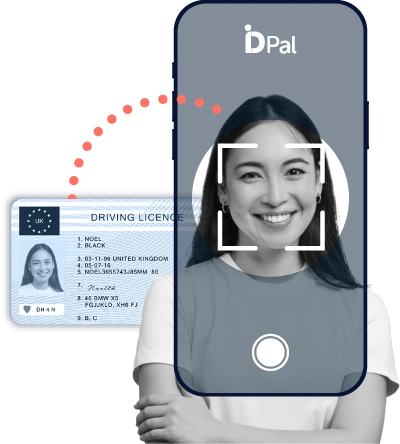
ID-Pal combines document authentication, biometric verification, liveness detection, database checks, and fraud intelligence into a single streamlined process. This allows you to reduce onboarding friction for genuine customers while strengthening protection against increasingly complex fraud threats. It also gives your compliance team greater confidence that customer due diligence processes are aligned with regulatory expectations and evolving financial crime risks.
If your organisation is reviewing its identity verification strategy, now is the time to assess whether your existing controls are equipped to deal with today’s fraud landscape. Investing in a modern ID&V solution like ID-Pal can help you detect fraudulent applications earlier, reduce operational burden, and build a stronger defence against identity document fraud across the entire customer lifecycle.